What Is NPS and How Do You Calculate It? A Plain Guide for Small Businesses
What is the Net Promoter Score (NPS), how do you calculate it and how should you read the result? A worked example and practical tips for small businesses.
Would you like to measure how happy your customers are with a single number? The Net Promoter Score, usually shortened to NPS, does exactly that. Large companies use it widely, yet it is very simple, and it is one of the easiest places for a small business to start.
What is NPS?
NPS asks customers one question: "How likely are you to recommend us to a friend?" The customer answers on a scale from 0 to 10. The method was developed by Frederick Reichheld of Bain & Company and introduced in a 2003 Harvard Business Review article. The idea is simple: when customers are ready to recommend you to others, their satisfaction is more than words.
Customers fall into three groups
- Promoters (9–10): Happy customers who will recommend you.
- Passives (7–8): Satisfied but not loyal; they may leave for a better offer.
- Detractors (0–6): Unhappy customers who may speak badly of you to others.
How to calculate NPS
Subtract the percentage of detractors from the percentage of promoters. Passives are left out.
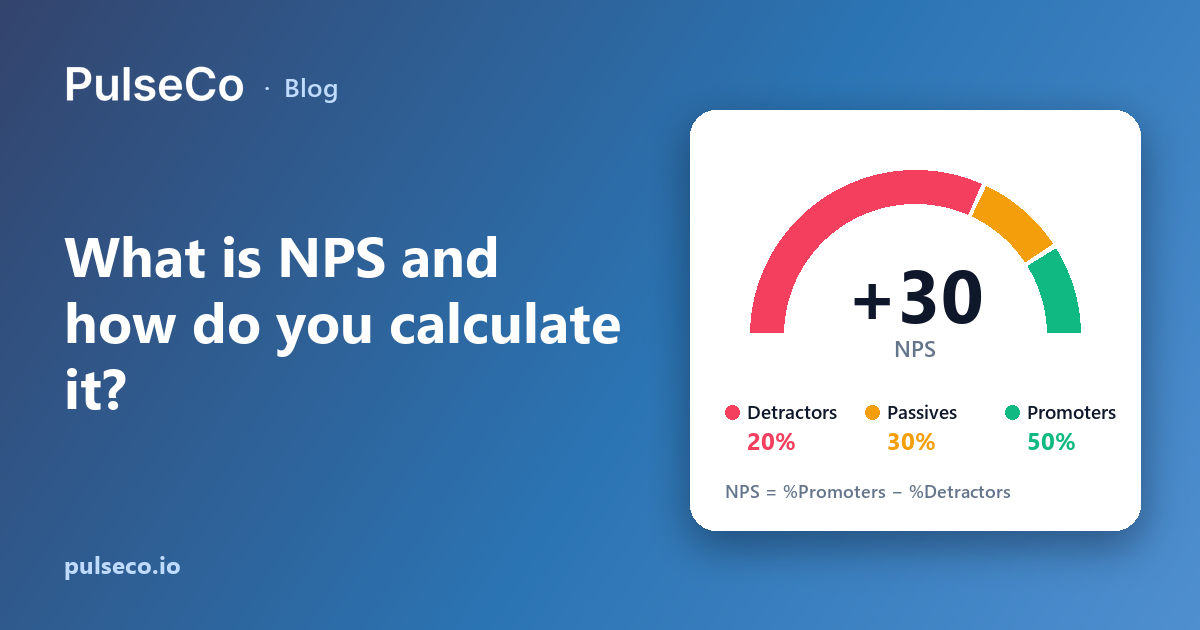
NPS = % of promoters − % of detractors
Example: You received 100 responses. 50 people scored 9 or 10, 30 people scored 7 or 8, and 20 people scored between 0 and 6. Promoters are 50%, detractors 20%. NPS = 50 − 20 = +30.
NPS is not a percentage but a score between −100 and +100. If everyone is a detractor it is −100; if everyone is a promoter it is +100.
How to read your score
- Compare with yourself. There is no single answer to "what is a good NPS?"; it varies a lot by industry and country. What matters most is whether your score rises month after month.
- Don't jump to conclusions with few responses. With 10 responses, one customer moving from detractor to promoter shifts your NPS by 20 points. Wait for responses to build up before talking about a trend.
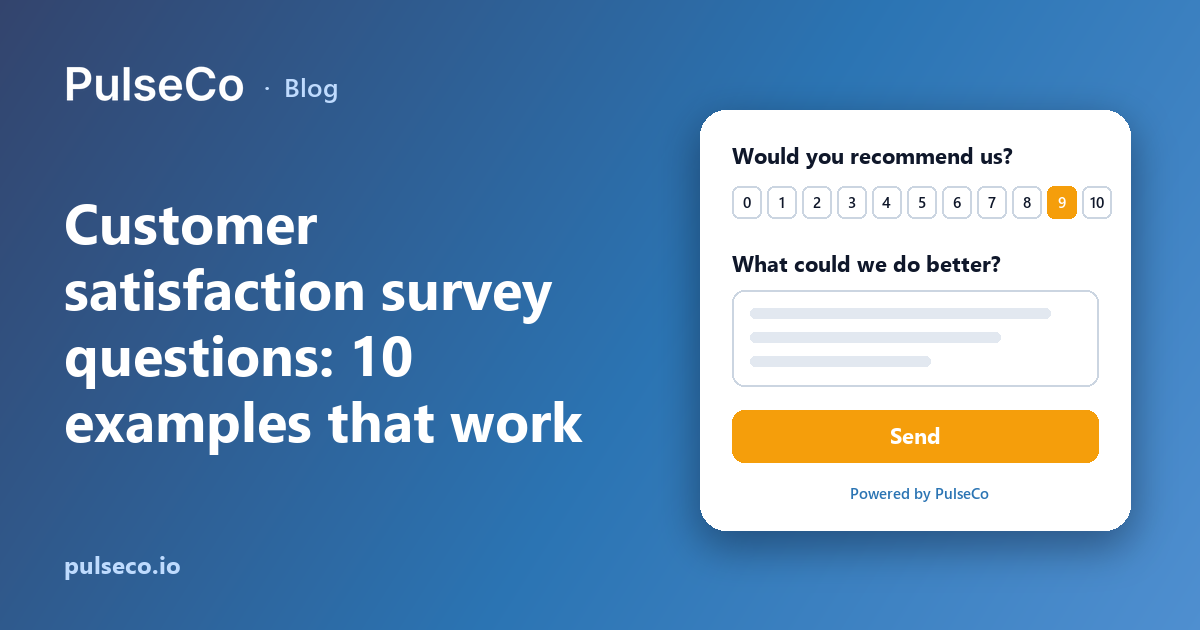
- The number tells you "what", the comment tells you "why". Always pair the NPS question with an open question such as "What could we do better?". When your score drops, the reason is in the comments. For more question ideas, see our article on customer satisfaction survey questions.
Three tips for small businesses
- Ask at the right moment. The page after checkout, a QR code on the table or a message after an appointment are moments when the experience is still fresh.
- Read detractors straight away. Getting back to a customer who scored 0–6 is your fastest chance of keeping them.
- Look regularly. Check your NPS weekly, not once a year. That is the only way to see the effect of a change you make.
Measure NPS automatically with PulseCo
PulseCo adds the NPS question to your website, a table or a receipt in a few minutes and calculates your score for you. Comments are sorted into topics, you get an email when a low score comes in, and every morning your report shows what changed. Try it free for 14 days, no card required.
Source: Frederick F. Reichheld, "The One Number You Need to Grow", Harvard Business Review, December 2003.